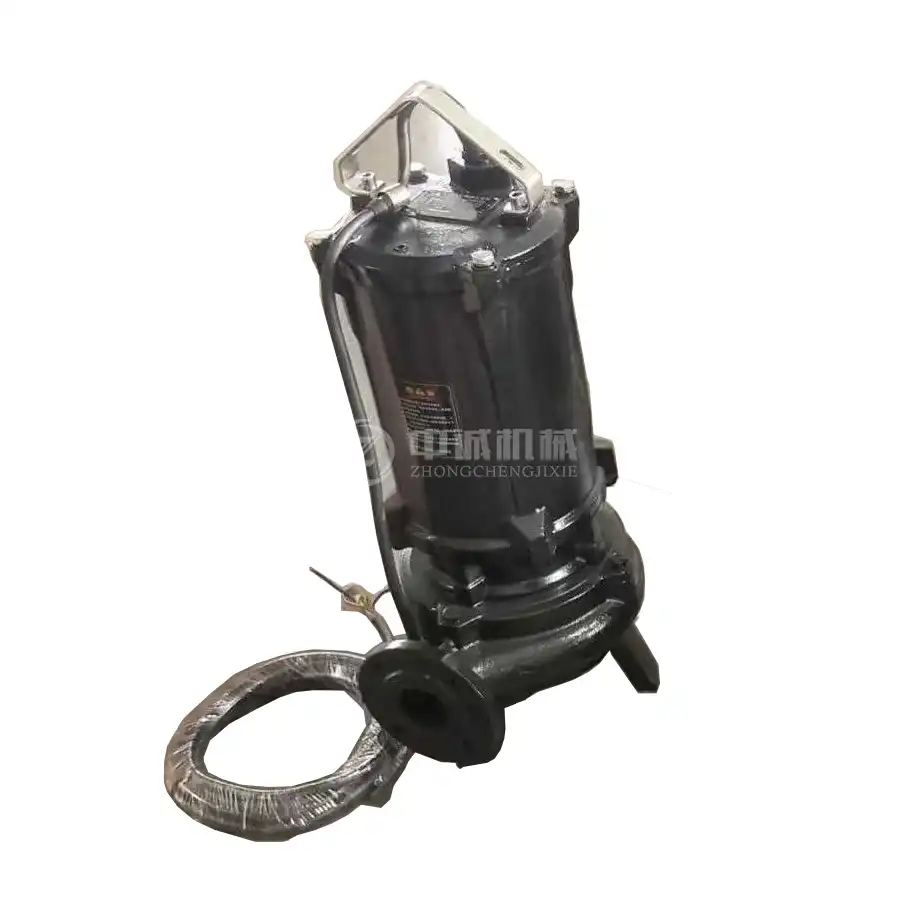
A submersible slurry pump is a heavy-duty centrifugal pump built to transfer highly abrasive, high-density fluids while operating fully submerged inside the tank or pit. In drilling mud tank systems, this type of pump handles the continuous circulation of weighted drilling fluid loaded with drill cuttings, sand, and fine solids. Because the pump sits directly in the slurry, it eliminates suction-lift problems and the risk of cavitation. For oilfield operators, drilling contractors, and geotechnical engineers, that means more stable mud properties, fewer interruptions, and lower fluid loss over the life of a well.
Understanding Submersible Slurry Pumps in Drilling Mud Tank Systems
How the Pump Works Inside a Mud Tank
The motor and wet end of the pump are joined together to make a single sealed unit that is dropped into the tank. A high-chrome impeller speeds up the slurry as it moves out through the volute casing. This creates enough head to push the fluid to the next tank section, the mixing hopper, or the main circulating pump's suction manifold. The unit can handle most onshore rig setups from ZJ30 to ZJ90. Its head range is 6–26 m, and its volume is 20–280 m³/h.
The Role of the Integral Agitator
A lot of them have a stirrer at the bottom that spins just above the tank floor. It makes a controlled vortex that keeps objects that have settled in the liquid from reaching the turbine. If this feature isn't there, heavy barite and drill cuttings would build up at the bottom, starving the pump and causing changes in density that would make it hard to figure out the downhole pressure.
Where It Fits in the Solid Control Circuit
The submersible slurry pump is typically installed in the active mud tank or suction tank within a complete solids control system. It transfers conditioned drilling fluid to the mixing section, helping maintain a stable flow throughout the mud treatment process. Working alongside equipment such as the centrifuge, desander, desilter, and shale shaker, the submersible slurry pump supports consistent fluid circulation and helps keep solids content within the required operating limits. For drilling contractors, selecting the appropriate submersible slurry pump according to flow requirements, tank configuration, and fluid characteristics can improve overall system coordination. Proper installation and maintenance of the submersible slurry pump can further support reliable fluid transfer and stable solids control performance. A correctly configured submersible slurry pump is therefore an important component of an efficient drilling-fluid treatment system.
Benefits of Using Submersible Slurry Pumps in Mud Tank Systems
The submerged design gets rid of a number of issues that surface-mounted slurry transfer pumps often cause on busy rig sites.
Here are the benefits that drilling teams say are most useful:
- No suction-lift limitation. Because the pump operates below the fluid surface, it does not need to overcome atmospheric pressure to move fluid. This is especially valuable in deep sumps or when mud weight rises above 1.8 SG.
- Compact footprint. The unit requires no external support frame, long drive shaft, or coupling guard. It lowers directly into the tank, freeing deck space for other equipment.
- Reduced seal wear. Surface centrifugal pumps that handle abrasive slurry through long suction lines experience accelerated shaft seal wear. The submerged design eliminates that suction path entirely, cutting seal replacement frequency.
- Continuous operation stability. Motor cooling relies on the surrounding fluid rather than ambient air. In desert or high-temperature environments where air cooling falters, this keeps the motor within safe temperature limits.
Because of these benefits, there will be fewer unexpected shutdowns, which are always the biggest cost worry for managers of drilling operations. The International Association of Drilling Contractors did a study in 2022 that said unplanned downtime costs onshore operators between $15,000 and $50,000 per day, based on the type of rig. One of the cheapest ways to lower that risk is to use reliable fluid movement tools.
How to Select the Right Submersible Slurry Pump for Your Drilling Mud Tank
Picking the wrong pump leads to earlier wear, uneven flow, and expensive repairs or replacements. Four things should be confirmed by engineers before choosing a unit.
Flow Rate and Head Requirements
Match the pump's flow rate (m³/h) to the amount of mud that needs to be moved every hour, taking into account the total volume of the rig and the number of tank compartments. There should be 80 to 160 m³/h of transfer rates for a ZJ50 rig at 10 to 18 m of head.
Slurry Density and Solid Particle Size
Drilling fluids that are oil-based or high-weight water-based can reach densities of 2.2 SG or higher, so the submersible slurry pump must be designed to handle the required specific gravity range. Both the impeller and pump housing of a properly selected submersible slurry pump should have sufficient strength and wear resistance for these demanding fluid conditions. Large-passage impellers can accommodate solid particles up to 60–75 mm in diameter, helping the submersible slurry pump reduce the risk of clogging compared with conventional industrial pumps. For demanding drilling applications, choosing a submersible slurry pump with the appropriate passage size, material construction, and hydraulic capacity can support stable fluid transfer. Properly matching the submersible slurry pump to drilling-fluid density and solids characteristics can also help maintain reliable operation and reduce maintenance caused by blockages.
Material Selection for Abrasion Resistance
Most impellers, casings, and wear plates that are used in abrasive slurry work are made of a high-chrome metal (27% Cr, hardness above 60 HRC). Before being put together, every wet-end part at ZHONGCHENGJIXIE goes through spectrographic material testing to make sure the chrome content meets wear-life requirements.
Common Challenges and Maintenance Tips for Submersible Slurry Pumps in Mud Systems
Impeller Wear and Flow Degradation
Over time, impeller wear drops the flow rate and hydraulic efficiency. A first sign can be found by keeping an eye on the pump output pressure over time. If the pressure drops by more than 15% from the starting point, it's usually time to check the impeller clearance.
Seal Leakage and Motor Moisture Ingress
When a mechanical seal fails, slurry can move toward the motor shaft. A triple-protection system with two moisture sensors, thermal sensors in the windings, and epoxy-sealed wire openings lets you know right away if the motor is damaged. A simple way to keep things from breaking down is to check the monitor data every 250 hours.
Clogging from Oversized Solids
When cuttings pass through the primary shakers and enter the active tanks, solids that are too large for the impeller can become trapped and cause blockages in the submersible slurry pump. Most clogging issues can be reduced by selecting the appropriate mesh size for the upstream screen and visually inspecting the tanks during every shift. If a blockage occurs, many submersible slurry pump designs allow operators to access the impeller by lifting the pump out of the tank without disconnecting the discharge line. This maintenance-friendly design can help reduce downtime and simplify troubleshooting. Regular inspection and proper screening can also help keep the submersible slurry pump operating efficiently when handling drilling fluids containing abrasive solids. For drilling contractors, choosing a submersible slurry pump with convenient maintenance access can further improve serviceability and long-term reliability.
Leading Brands and Supplier Considerations for Submersible Slurry Pumps
There are a number of companies that make slurry transfer pumps for the drilling industry. In different areas, Flygt, Warman, and Ebara have all built good names. Flygt is the market leader in municipal and drainage. Warman has a long history in processing minerals. Ebara works with a lot of different industries. Working directly with a manufacturer that focuses on drilling equipment is often better than getting through a distributor for oilfield-specific uses that need custom tank integration, motor choices that match rig power systems, and quick project delivery.
Since 2015, ZHONGCHENGJIXIE has provided mud circulation systems for onshore drilling projects in a number of different regions. The company's engineers have over 30 years of experience working on these systems. The business is certified by ISO 9001, ISO 14001, ISO 45001, HSE, TÜV, and BV. The slurry pump units it sells come with full hydraulic test records, material certificates, and a warranty that covers everything for one year. In-stock models can be sent out within three days, and special setups for certain types of rigs are sent out within fifteen days.
Conclusion
In digging mud tank systems, submersible slurry pumps have a very important job to do. They keep rough, dense fluid moving consistently between tank parts without the problems with seals and suction lift that come with surface-mounted options. When set up correctly—with the right flow rate, head, slurry density, and material grade—they increase the time that the mud system is operational and lower the amount of fluid that is lost. The right slurry transfer pump is an important practical choice for procurement managers and drilling engineers planning their next mud system build or upgrade. It affects the daily productivity of the rig and the long-term cost of the equipment.
FAQ
What is the difference between a submersible slurry pump and a standard centrifugal pump?
A standard centrifugal pump sits above the fluid and draws slurry up through a suction line. A submersible slurry pump operates fully submerged, eliminating suction lift and cavitation risk. Its wet-end components are also built from harder materials — typically high-chrome alloy — to resist the abrasion that would rapidly erode a standard centrifugal pump casing.
What solid concentration can these pumps handle?
Heavy-duty units handle slurries with up to 60% solids by weight. The large impeller passages in ZHONGCHENGJIXIE models accommodate solid particles up to 60–75 mm in diameter without clogging.
How often should wear parts be replaced?
In standard sand-pumping service, a high-chrome impeller lasts 3,000–5,000 operating hours. Actual life depends on slurry abrasiveness, pH, and density. Tracking discharge pressure provides an objective indicator of wear before performance drops significantly.
Can the pump operate in low mud levels?
Most units include a motor cooling jacket that allows operation in low-water or "snoring" conditions without overheating, providing operational flexibility during tank cleanouts or volume fluctuations.
What motor power range is available?
ZHONGCHENGJIXIE submersible slurry pump units are available from 3 kW to 45 kW, covering transfer requirements for rig classes from ZJ30 through ZJ70.
Request a Quote from ZHONGCHENGJIXIE — Submersible Slurry Pump Manufacturer
ZHONGCHENGJIXIE sells certified submersible slurry pump units that have been used in the field. These units come with full technical documentation, a one-year warranty, and fast delivery. Our engineering team is ready to help you whether you need a normal setup or a build that is made just for your rig class. Please email us at oliver@zcgukong.com or visit zcsolidscontrol.com right away to talk about your project needs and get a detailed equipment proposal.
References
1. International Association of Drilling Contractors (IADC). Drilling Manual, 12th Edition. IADC, 2015.
2. Bourgoyne, A.T., Millheim, K.K., Chenevert, M.E., & Young, F.S. Applied Drilling Engineering. Society of Petroleum Engineers, 1986.
3. Nelik, L. Centrifugal and Rotary Pumps: Fundamentals with Applications. CRC Press, 1999.
4. Gülich, J.F. Centrifugal Pumps, 3rd Edition. Springer, 2014.
5. American Petroleum Institute. API RP 13C: Recommended Practice on Drilling Fluids Processing Systems Evaluation. API, 2010.
6. Wilson, K.C., Addie, G.R., Sellgren, A., & Clift, R. Slurry Transport Using Centrifugal Pumps, 3rd Edition. Springer, 2006.